If you are planning to pursue an MBA after graduation, NMAT by GMAC is one of the management entrance exams worth considering. Its biggest practical advantages are flexible scheduling, the possibility of multiple attempts within the testing cycle, and acceptance by a range of Indian B-schools.
But NMAT should not be treated as simply an easier version of CAT. The paper has strict section-wise clocks, questions cannot be revisited, and colleges use their own cutoffs and selection criteria. The right target is therefore not just "clear NMAT", but to understand which score opens which opportunities.
NMAT 2026 at a Glance
Feature
NMAT 2026
Conducting body
Graduate Management Admission Council (GMAC)
Sections
Language Skills, Quantitative Skills, Logical Reasoning
Questions
108
Total duration
120 minutes
Total score range
36–360
Section score range
12–120 each
Negative marking
No
Section timing
28 min + 52 min + 40 min
Attempts
Up to 3 in a testing cycle
Score availability
Usually within 48 hours
What is NMAT?
NMAT by GMAC is a computer-based management entrance examination used by several business schools for MBA and related programmes. GMAC describes the test as having three individually timed sections. Questions are delivered one at a time and selected from a question pool based on the candidate's performance.
The exam is scored on a scaled range rather than by simply counting correct answers. Each section carries a score range of 12–120, giving a total range of 36–360.
Eligibility
NMAT itself does not replace the admission rules of individual B-schools. For a regular MBA, students from different undergraduate streams can generally apply, while the institute decides the minimum graduation marks, final-year conditions and any programme-specific requirements.
Important — NMAT eligibility and admission eligibility are not the same thing. Always check the current admission notice of the specific institute you want to join.
NMAT 2026 Important Dates
Verify the official GMAC calendar before treating any 2026 date as final. The previous cycle provides a useful reference point, but it should not be presented as the confirmed 2026 schedule.
Event
NMAT 2025
NMAT 2026 status
Registration
1 Aug 2025 onward
Check official GMAC announcement
Exam window
5 Nov–19 Dec 2025
To be confirmed
First-attempt fee
₹3,000 + taxes
Verify current fee before payment
Retake fee
₹3,000 + taxes
Verify current fee before payment
Rescheduling
₹1,200 + taxes
Verify current fee before payment
The 2025 cycle shows why early scheduling matters: candidates could choose their slot within the exam window, subject to availability.
Exam Pattern
Section
Questions
Time
Score range
Language Skills
36
28 minutes
12–120
Quantitative Skills
36
52 minutes
12–120
Logical Reasoning
36
40 minutes
12–120
Total
108
120 minutes
36–360
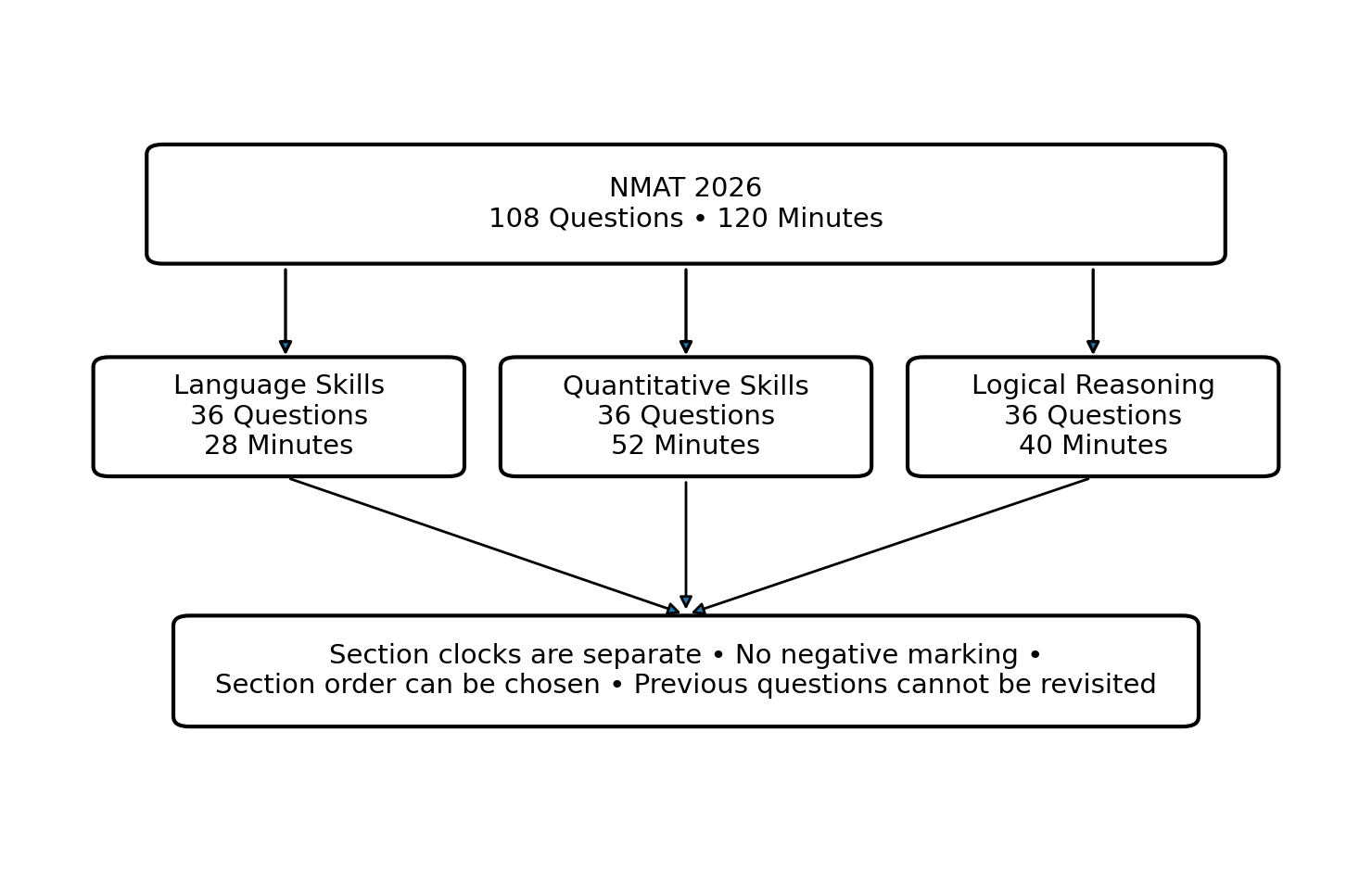
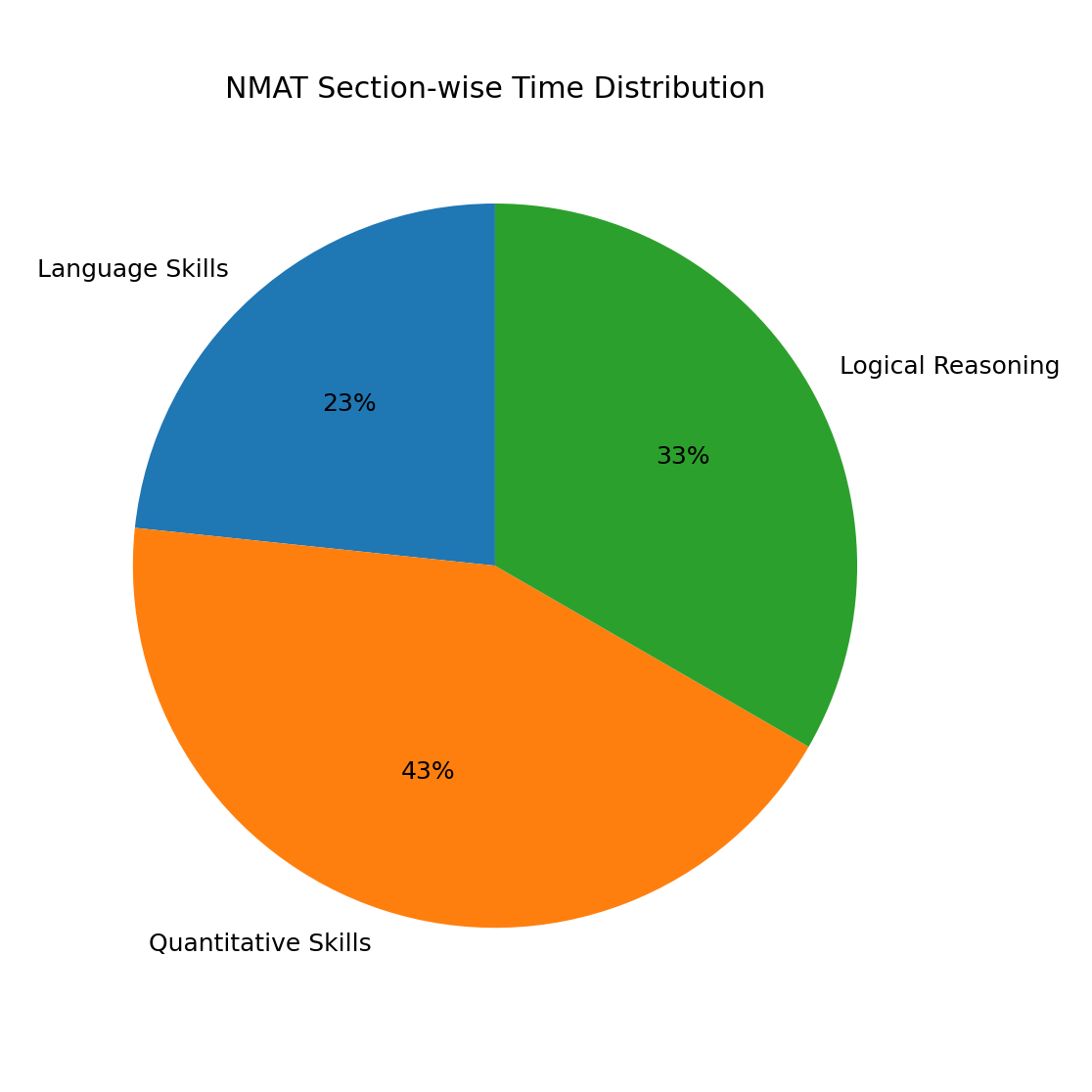
The time distribution is deliberately uneven. Quantitative Skills gets the largest share of the 120-minute window, while Language Skills has the shortest clock.
NMAT Syllabus: Section-wise Topic Map
Section
Core areas
What to practise
Language Skills
Reading Comprehension, Para Forming, Error Identification, Prepositions, Sentence Completion, Analogies
Number Properties, Arithmetic, Algebra, Probability, Data Integration (caselets, tables, graphs, charts), Data Sufficiency
Fast calculations, arithmetic application, interpretation and decision-making under time pressure
Logical Reasoning
Critical Reasoning, Analytical Puzzles, Deductions, Other Reasoning
Pattern recognition, logical inference, arrangement and argument evaluation
This format is more useful than memorising a long chapter list: it tells you both what appears in the official structure and what skill each area demands.
A Key NMAT Rule: Section-wise Timing
Think of NMAT as a speed-and-decision-making exam: each section has its own clock, you cannot go back to earlier questions, section order can be chosen, and there is no negative marking. These rules should shape your mock strategy from the beginning.
Registration to Admission: The Complete Process
The process is straightforward: register for NMAT → schedule the test → take the exam → receive your score → apply separately to the B-schools you want → clear the institute's shortlist and selection rounds → receive the final admission decision. The important point is that NMAT registration and college applications are separate.
For NMIMS in particular, students should carefully read the current admission rules regarding which NMAT attempt is considered.
Top NMAT-accepting B-Schools: Quick Comparison
Institute
Indicative / reported NMAT level
Approx. total fee*
Selection note
NMIMS Mumbai
209 reported cutoff
~₹25 lakh
Highly competitive; institute-specific process
K J Somaiya Institute of Management
~224–230 expected/reported range
~₹20.87 lakh
Cutoff and programme requirements can vary
SDA Bocconi Asia Center
~220+ indicative
~₹20.75 lakh
Check programme-specific admission rules
XIM University / XIMB programmes
~90 percentile / score varies by programme
~₹19 lakh for referenced programme
Programme-specific NMAT acceptance
Great Lakes Institute of Management
Varies by programme
Varies
Check whether NMAT is accepted for your programme
*Fees shown are indicative/previously reported figures, not a universal 2026 fee. Always verify the current institute fee before applying.
NMAT Cutoffs: Score Comparison
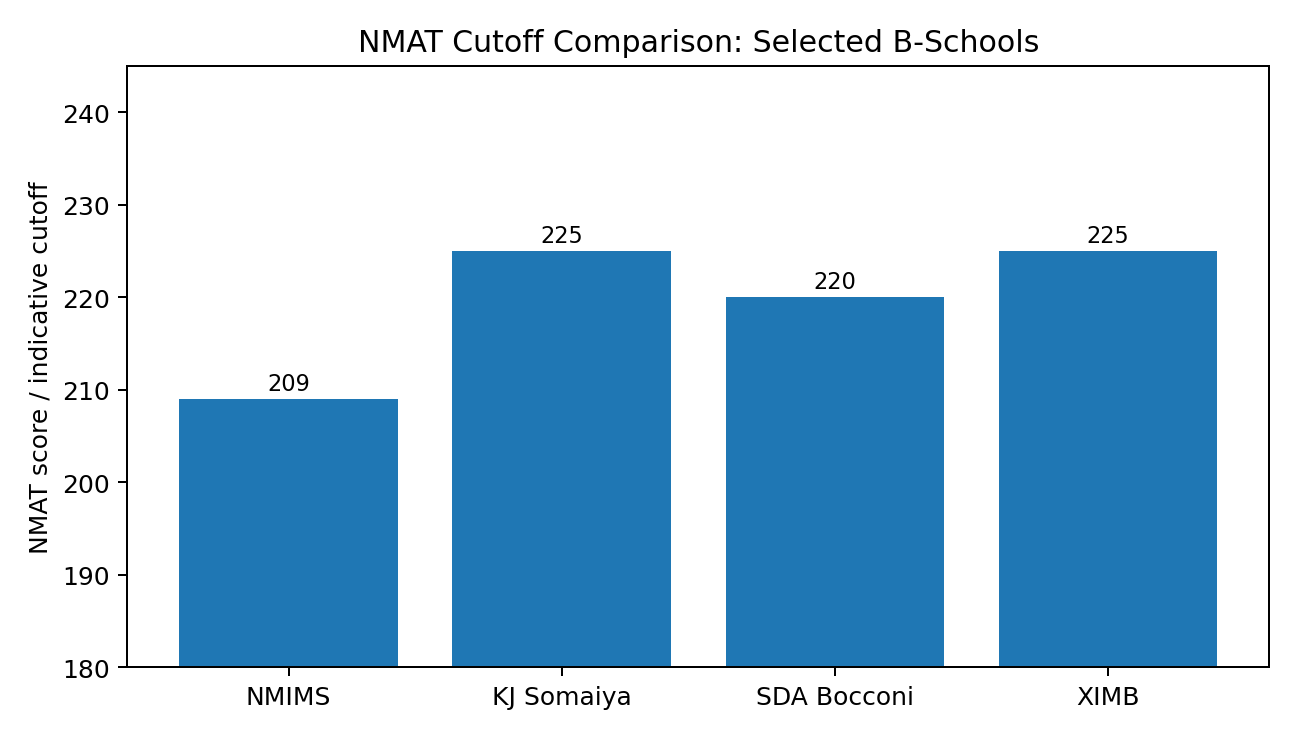
There is no single NMAT cutoff. The number that matters depends on the institute, programme, year and selection policy. The table below deliberately separates a reported/official figure from indicative or expected ranges.
College / programme
Cutoff status
Score / range
How to read it
NMIMS MBA
Reported cutoff for recent cycle
209
Minimum reported threshold; not a guaranteed convert
K J Somaiya
Expected/reported range
224–230
Treat as indicative; competition and programme matter
SDA Bocconi
Indicative
220+
Use as a target range, not an official fixed cutoff
XIMB / XIM University
Indicative
Varies
Programme-specific rules apply
Other NMAT colleges
Varies
Often 200+ for competitive options
Research each institute separately
A practical target should be higher than the minimum cutoff. For students aiming at the most competitive NMAT options, building a buffer above the reported cutoff is more sensible than preparing to score exactly at it. A cutoff is a threshold, not a promise of conversion.
NMIMS Placement Snapshot
Programme
Average salary
Interpretation
MBA Core
₹25.13 lakh
Institute-reported average salary
MBA HR
₹18.64 lakh
Institute-reported average salary
NMIMS School of Business Management reports 190 recruiting companies and the above average salary figures on its placement page. These are institute-reported averages, not guaranteed individual salaries.
NMAT vs CAT: What Changes in Preparation?
Factor
NMAT
CAT
Negative marking
No
Yes
Section timing
Individually timed
Section-wise timing
Question review
Cannot return to previous questions
Different review/navigation structure
Attempts
Up to 3 in a testing cycle
One scheduled attempt
Main challenge
Speed + decision-making
Difficulty + accuracy + strategy
The overlap in Quant, Reasoning and English means CAT preparation can build much of your base. NMAT-specific practice is still necessary because the pacing and navigation rules are different.
Preparation Strategy
1. Start with a diagnostic test
Take one NMAT-style test before changing your routine. Record your section scores, average time per question, unanswered questions and recurring error types.
2. Build the high-frequency base
Strengthen arithmetic, basic algebra, numbers, reading comprehension, grammar, critical reasoning and common puzzle types. Do not chase obscure topics while your fundamentals are weak.
3. Shift to timed practice
Once concepts are stable, solve section-wise sets under the actual NMAT clocks. Your objective is not just to get questions right; it is to make good decisions quickly.
4. Introduce mocks gradually
Use full-length mocks to test pacing and selection. After each mock, label every wrong or skipped question as a concept gap, calculation/reading error, time-management problem or poor question selection — then fix the largest category first.
5. Practise the exact exam environment
Use official practice material and full-length tests that reproduce NMAT's section timing and navigation rules. GMAC's official guide and practice resources are particularly useful for understanding the actual format.
Common Mistakes to Avoid
Most NMAT mistakes are strategic rather than conceptual:
Preparing for NMAT exactly like CAT.
Ignoring the section clocks.
Spending several minutes rescuing one difficult question.
Taking mocks without analysing them.
Treating one institute as your only option instead of keeping multiple target colleges.
Frequently Asked Questions
Is NMAT easier than CAT?
The difficulty profile is different. NMAT can feel more manageable in some areas, but its strict section clocks and no-review rule make speed and decision-making critical.
How many times can I take NMAT?
GMAC allows up to three attempts in a testing cycle, including the first attempt and up to two retakes. Individual institutes can decide which attempt or score they accept.
Is there negative marking?
No. NMAT currently has no negative marking.
What score should I target for NMIMS?
The latest reported NMIMS MBA cutoff used in this guide is 209. Treat that as a threshold, not a safe target. A higher score gives you a better buffer, although admission also depends on the institute's overall selection process.
When should I start preparing?
If you are already preparing for CAT, begin NMAT-specific preparation after your core concepts are stable. The main shift should be towards speed, section timing and repeated full-length practice.
Important: NMAT dates, fees, cutoffs and programme fees change by cycle. Exam structure is based on GMAC's published information; placement figures are institute-reported and indicative cutoffs are labelled as such. Always recheck the official GMAC and institute notices before applying.
Put this into practice
8,500+ practice questions, true-to-exam mocks and analysis — start free on AthenaPrep.