The Symbiosis National Aptitude Test (SNAP) is a short, speed-based management entrance exam — 60 questions in 60 minutes — and your route into the Symbiosis group of B-schools. This guide covers the exam date, eligibility, pattern, cutoff trend, colleges, fees, placements and a practical preparation plan for SNAP 2026.
SNAP at a glance — 60 questions · 60 minutes · 3 sections · up to 3 tests · 17 MBA institutes · 29 MBA programmes.
What is SNAP?
The Symbiosis National Aptitude Test (SNAP) is conducted by Symbiosis International (Deemed University) for admission to postgraduate management programmes offered by Symbiosis institutes. The paper is short and speed-based: candidates have 60 minutes for 60 questions.
For a student, this changes the way preparation should be approached. Knowing concepts is necessary, but quickly identifying the right questions and avoiding time traps can make a major difference.
Why students consider SNAP — SNAP opens the route to multiple Symbiosis management institutes, including SIBM Pune, SCMHRD Pune, SIIB Pune, SIBM Bengaluru, SIOM Nashik, SICSR Pune and others.
SNAP 2025 vs SNAP 2026
SNAP 2025 was conducted on December 6, 14 and 20, 2025, and the result was announced on January 9, 2026. Official SNAP 2026 test dates have not yet been announced on the official dates page.
Event
2025
2026
Test 1
6 Dec
To be announced
Test 2
14 Dec
To be announced
Test 3
20 Dec
To be announced
Result
9 Jan 2026
To be announced
Use the previous cycle only as a reference. Do not treat the 2025 dates as the official 2026 schedule until Symbiosis publishes the new dates.
Eligibility
Candidates need a graduation degree from a recognised university or institution. The basic requirement is 50% or equivalent marks for general candidates and 45% for SC/ST candidates.
Final-year students can apply subject to the stated conditions. Work experience is not required for the basic SNAP test. Individual institutes and programmes may have additional eligibility rules.
Eligibility in one line — Graduation + 50% (general) / 45% (SC/ST) · Final-year students can apply · No mandatory work experience.
Application Process
Register on the SNAP portal.
Fill details — academic and personal information.
Choose test(s) — up to three attempts.
Choose programmes at the participating institutes.
Pay the fee.
Download the admit card.
For SNAP 2025, the test registration fee was ₹2,250 per test plus applicable taxes, and programme registration was ₹1,000 plus applicable taxes per programme. Check the 2026 portal for the current fee before payment.
Exam Pattern
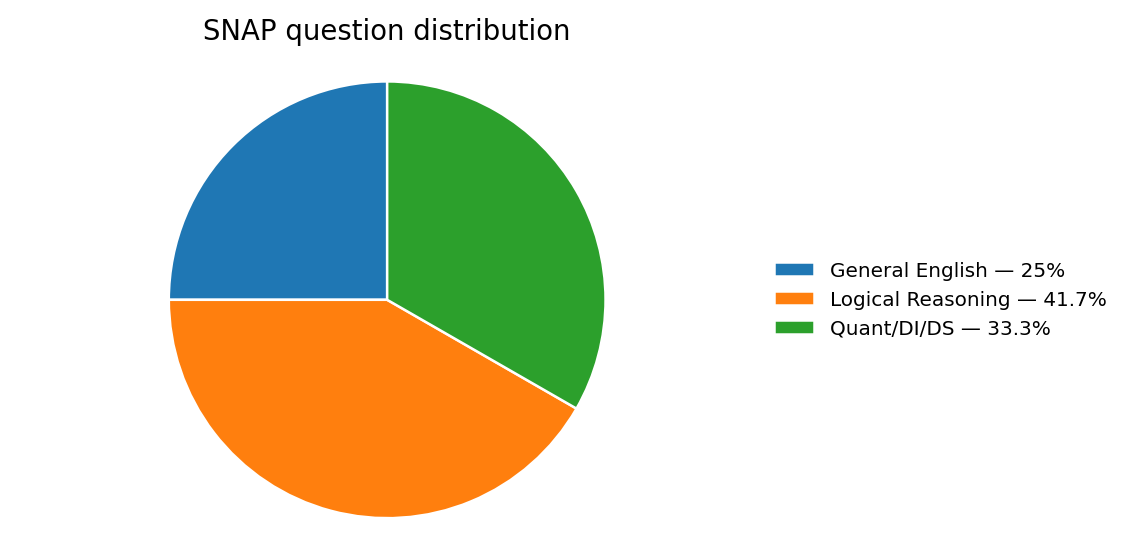
The latest official pattern has three sections. The total is 60 questions for 60 marks, to be completed in 60 minutes. Candidates can attempt sections in any order.
Section
Questions
General English
15
Analytical & Logical Reasoning
25
Quantitative, DI & DS
20
Reasoning carries the largest share of questions.
Scoring — Each correct answer earns 1 mark. An incorrect answer attracts 25% negative marking. The short paper makes speed, accuracy and question selection equally important.
SNAP Syllabus
General English includes reading comprehension, verbal ability, verbal reasoning, vocabulary and grammar. Analytical & Logical Reasoning includes arrangements, series, puzzles and other analytical reasoning types. Quantitative, Data Interpretation & Data Sufficiency covers arithmetic, algebra, geometry, numbers, DI and data sufficiency. A section-wise syllabus is most useful as a checklist rather than something to memorise.
Three preparation buckets — English → reading + verbal skills · Reasoning → patterns + logical structures · Quant/DI/DS → concepts + calculation + data handling.
SNAP Cutoff: Previous-Year Trend
There is no single cutoff for every Symbiosis institute. Exact shortlisting cutoffs are not generally announced as one official number in advance. The following are estimated 2025 percentile trends and should be treated as target ranges.
Institute
Estimated 2025 cutoff
SIBM Pune
98.5+
SCMHRD Pune
98+
SIIB Pune
93+
SIBM Bengaluru
93+
SIOM Nashik
87+
Other recent estimates were around 83+ for SIDTM Pune and SIBM Nagpur, 82+ for SICSR Pune, 77+ for SIMS Pune and 76+ for SCIT Pune. These are not guaranteed admission cutoffs.
What should you target? — If SIBM Pune or SCMHRD is your primary target, aim for the highest possible percentile rather than preparing around the minimum estimate. Cutoffs can move with difficulty, competition, seats and institute-level shortlisting.
SNAP Colleges
The official SNAP website currently lists 17 MBA institutes and 29 MBA programmes. Popular options include SIBM Pune, SCMHRD Pune, SIIB Pune, SIBM Bengaluru, SIOM Nashik, SICSR Pune, SIDTM Pune, SIMS Pune and SCIT Pune.
The right college depends on the programme you want. For example, a student interested in operations should evaluate SIOM differently from a student targeting a general MBA at SIBM Pune.
Shortlist smartly — Compare the programme, fee, placement outcomes, location, specialisation and selection process — not just the SNAP percentile.
Fees & Placements: What Do the Numbers Look Like?
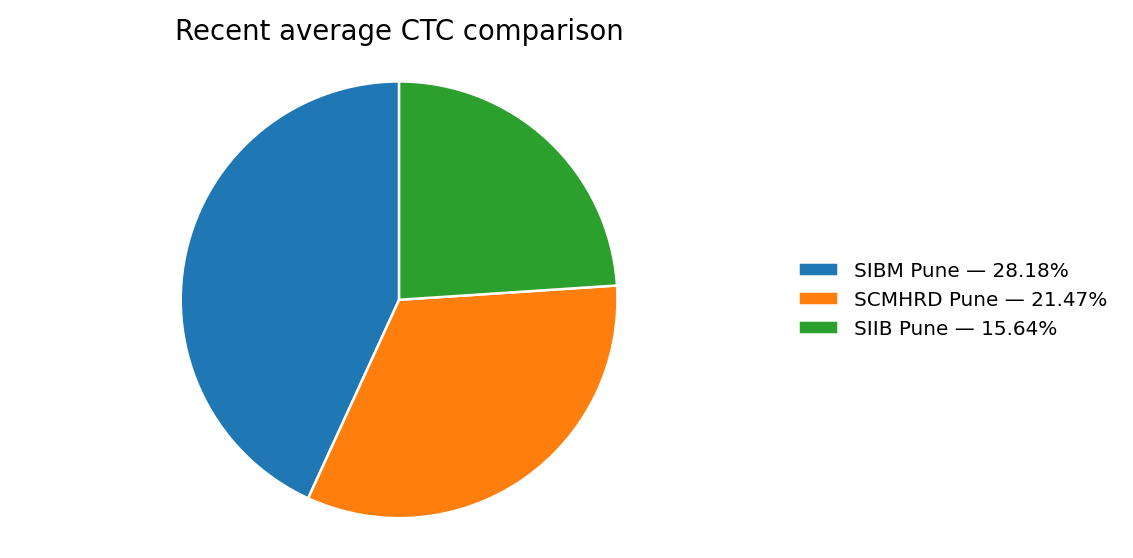
Fees vary substantially across Symbiosis programmes. Recent official figures also show that placement outcomes differ by institute and programme, so average CTC should not be used alone to judge value.
Institute
Approx. academic fee*
Recent average / mean CTC
SIBM Pune
₹13.10 lakh / 2 years
₹28.18 LPA
SCMHRD Pune
₹12.91 lakh / 2 years
₹21.47 LPA
SIIB Pune
₹20.62 lakh / 2 years
₹15.64 LPA
*Academic fee excludes hostel, mess and refundable deposits where applicable.
SIBM Pune's 2025 placement report recorded an average CTC of ₹28.18 LPA and a median CTC of ₹27 LPA. SCMHRD reported ₹21.47 LPA average and ₹20 LPA median for 2025–26. SIIB's latest available report reported ₹15.64 LPA average CTC.
Read placement numbers carefully — Look at median CTC, role quality, batch size and the programme's placement report along with the average package. A single highest-package number does not describe the experience of the whole batch.
SNAP Selection Process
SNAP test → Percentile → Institute shortlist → Selection rounds → Final merit list → Admission.
The exact post-SNAP selection process can vary by institute and programme. Shortlisting is therefore only one stage; candidates should check the individual institute's current admission criteria.
How to Prepare for SNAP
Start with a diagnostic test. You do not need to spend weeks studying everything before finding out where you stand — the first test should tell you whether your main problem is concepts, speed, accuracy, reading or question selection.
Build concepts section by section and then move quickly into timed practice. Since SNAP gives only one minute per question on average, regular timed sets are essential. Mocks are useful only when you analyse them: after every mock, record the questions you got wrong, guessed, left, or spent too long on.
A simple SNAP practice loop — Learn → Practise → Time yourself → Take a mock → Analyse → Revise → Repeat.
For official information, use the SNAP website for test and application details, and the individual Symbiosis institute websites for programme-specific admission information.
Common Mistakes
Preparing without timing — untimed practice can hide the speed problem.
Chasing every question — a difficult question can cost the time needed for two easier ones.
Taking mocks but not analysing them — the same mistakes then appear in the next test.
Following one cutoff blindly — cutoffs vary by institute and year.
Ignoring institute-specific criteria — a strong SNAP percentile does not automatically mean admission.
SNAP vs CAT vs XAT
SNAP makes the most sense when Symbiosis institutes are part of your target list. CAT has much wider acceptance across Indian management institutes, while XAT is particularly important for XLRI and several other XAT-accepting schools.
Quick comparison — SNAP → Symbiosis-focused and speed-heavy · CAT → widest IIM and B-school reach · XAT → XLRI and XAT-accepting institutes, with Decision Making.
Frequently Asked Questions
Is SNAP difficult?
The concepts are manageable for many students, but the 60-minute format makes speed and selection important.
Is there negative marking?
Yes. The latest official pattern has 25% negative marking for an incorrect answer.
How many times can I take SNAP?
The recent pattern allows up to three tests.
Can I apply to multiple Symbiosis institutes?
Yes. Programme-level registration and fees may apply separately.
Do all SNAP colleges have the same cutoff?
No. Cutoffs vary by institute and programme.
Can I prepare without coaching?
Yes. Structured self-study, official information, timed practice and careful mock analysis can be enough for many students.
Important: SNAP 2026 dates, fees, eligibility and cutoffs can change. For the latest details, always verify the official SNAP portal and the relevant Symbiosis institute website before applying.
Put this into practice
8,500+ practice questions, true-to-exam mocks and analysis — start free on AthenaPrep.